Was reading Drew DeVault's blog, and saw three cards at the bottom with links to posts on other sites, with a note "provided by openring".
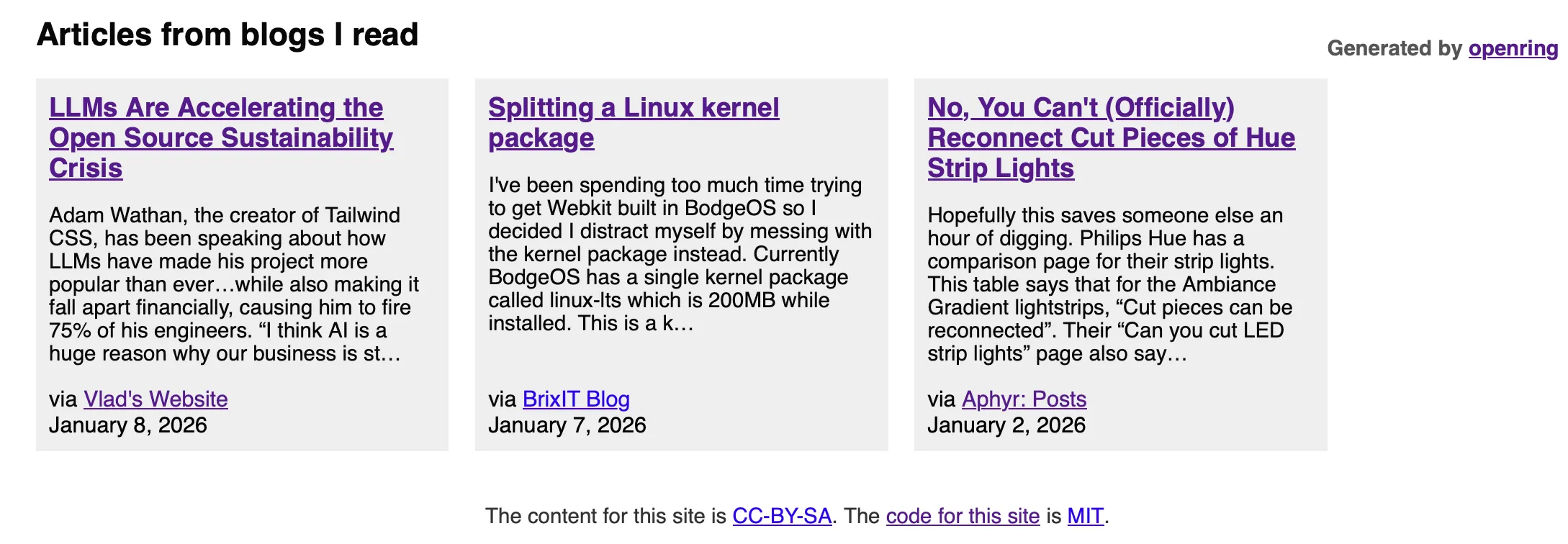
Looking into it, it's an open webring, in that you can create it yourself without group memberships controlled by a central party, it's just links between people.
I also saw openring-rs, a Rust based rewrite, that seemed pretty sweet.

This blog is built with Astro, so I worked to adapt it into TypeScript and to work with Astro's Content Collections.
The rewrite is available at https://tangled.org/calebjasik.jasik.xyz/astro-openring

There's three parts, the content collection loader, the getter for random posts, and the component that renders them. It uses round-robin to try to ensure that every RSS feed gets the same number of posts included, regardless of how often they post.
I tried reimplementing it in the same fashion as openring-rs then I was sad some of the blog authors dominated the selection, and I couldn't find eg: https://mango.pdf.zone among the blog posts. The round-robin helps with that. Each round, we go through each loaded feed and pull the latest feed item from it and save it to the content loader store. Then, we continue until num articles per feed and num articles are satisfied.
// Group articles by feed for fair distribution// This prevents prolific authors from dominating the selectionconst articlesByFeed = new Map<string, Article[]>();for (const article of allArticles) {  const feedArticles = articlesByFeed.get(article.feedUrl) ?? [];  feedArticles.push(article);  articlesByFeed.set(article.feedUrl, feedArticles);}
// Sort articles within each feed by date (newest first)for (const feedArticles of articlesByFeed.values()) {  feedArticles.sort((a, b) => b.pubDate.getTime() - a.pubDate.getTime());}
// Round-robin selection to ensure fair distribution across feeds// Round 0: Take newest article from each feed// Round 1: Take 2nd newest article from each feed (if available)// Round 2: Take 3rd newest article from each feed (if available)// Continue until we have `numArticles` totalconst selectedArticles: Article[] = [];const totalArticles = allArticles.length;let round = 0;
while (  selectedArticles.length < numArticles &&  selectedArticles.length < totalArticles) {  let addedThisRound = 0;
  for (const feedArticles of articlesByFeed.values()) {    if (round < feedArticles.length) {      selectedArticles.push(feedArticles[round]);      addedThisRound++;
      if (selectedArticles.length >= numArticles) {        break;      }    }  }
  // If no articles were added this round, we've exhausted all feeds  if (addedThisRound === 0) {    break;  }
  round++;}
// Clear articles array to free memoryallArticles.length = 0;
// Store the selected articlesfor (const article of selectedArticles) {  store.set({    id: article.id,    data: {      title: article.title,      link: article.link,      pubDate: article.pubDate,      summary: article.summary,      author: article.author,      feedUrl: article.feedUrl,      feedTitle: article.feedTitle,      feedLink: article.feedLink,    },  });}
I've been running into OOM errors when building with this, so I may need to get a little more antiquated with how to properly memory manage in TypeScript. For now, allocating 4GB instead of 2GB to nodejs in CI does the trick.
I’ve got to add the OpenRingSection and the random article loader to the astro-openring repo.
(this has been in the drafts since Jan 2026 lmao).